
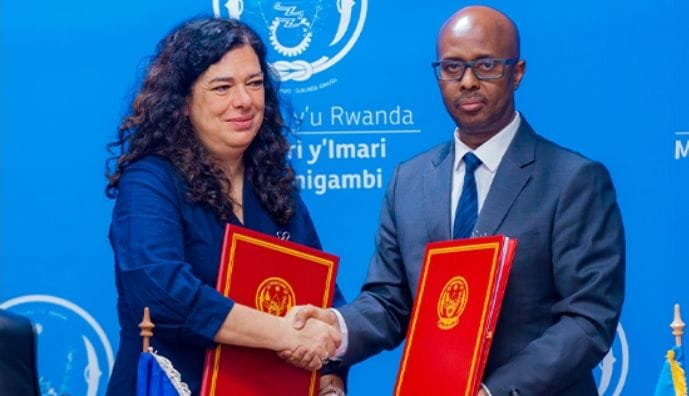
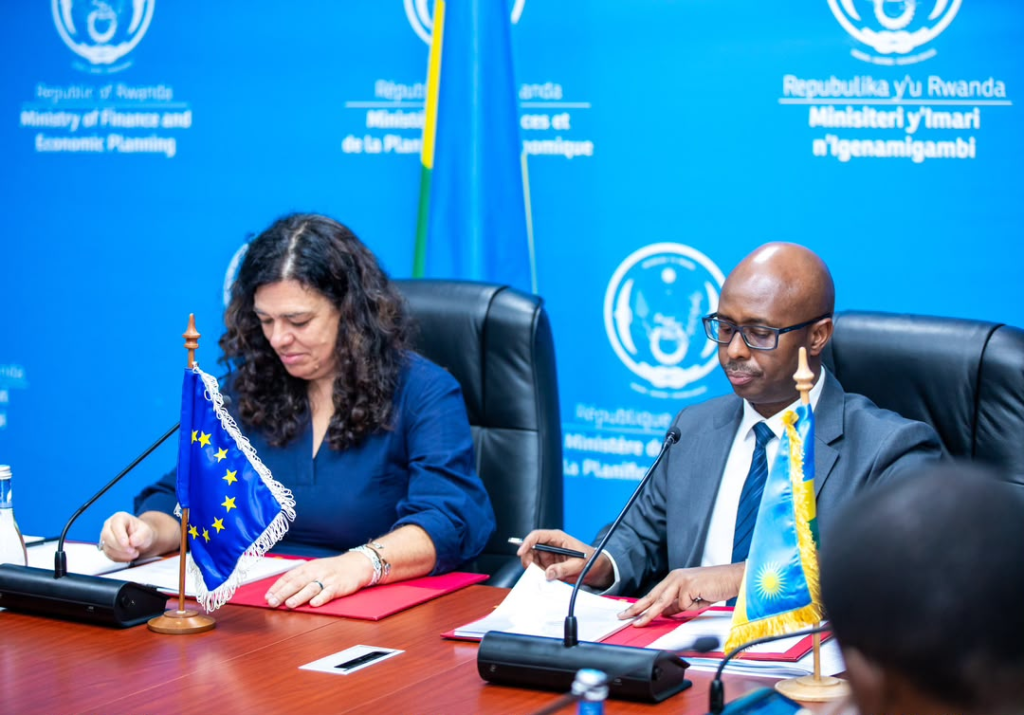
Rwanda and the European Union signed a Rwf67 billion agreement on August 4, funding a five year program built around a problem farmers across the country already feel every season: rainfall that no longer behaves the way it used to.
The agreement, officially titled “Hangaribihe: Transformational Climate Smart and Inclusive Agriculture in Rwanda,” was signed in Kigali between the Ministry of Finance and Economic Planning (MINECOFIN) and the EU. It’s part of the Team Europe Initiative on Investing in Sustainable and Inclusive Agricultural Transformation, which brings the EU together with other partners working toward the same goal. The €40 million package breaks down into €36 million in direct budget support for national agriculture and environment priorities, plus €4 million set aside for technical assistance, capacity building, and studies.
Where the Money Actually Goes
Finance Minister Yusuf Murangwa called the agreement a strategic partnership for the country’s agricultural transformation, one meant to build a productive, climate resilient sector by driving gains for smallholders, cooperatives, women, youth, and SMEs, while requiring climate smart, sustainable production methods along the way. That framing matters. The funding isn’t just aimed at output, it’s structured so that raising output and protecting the environment happen as one condition, not two separate goals competing for the same money.
Concretely, the program will fund expanded irrigation, sustainable land management, restoration of degraded ecosystems, and stronger climate information systems meant to help farmers and officials make decisions based on actual data rather than guesswork about the next rainy season.
An Ongoing Partnership, Not a One Off
EU Ambassador to Rwanda Belén Calvo Uyarra described the program as another milestone in a long running relationship between the EU and Rwanda, one built to turn the country’s climate smart agriculture ambitions into results farmers and rural communities can actually feel. The phrasing is worth noting. This isn’t introduced as a new direction for EU Rwanda cooperation, it’s presented as the next chapter of one that’s already been running for years, now aimed specifically at closing the gap between agricultural policy and what happens on the ground.
The Bigger Picture
Hangaribihe isn’t a standalone initiative. It’s built to reinforce two existing national frameworks, Rwanda’s second National Strategy for Transformation (NST2) and the fifth Strategic Plan for Agriculture Transformation (PSTA 5), alongside the country’s broader environment sector priorities. That positioning matters for how the funding will likely be judged over its five year run. This isn’t meant to be a separate climate project sitting next to Rwanda’s agricultural policy. It’s meant to be absorbed into it, funding the parts of the existing plan that climate volatility keeps threatening to undo.
For farmers already dealing with rainfall that arrives too suddenly, too heavily, or not at all, the real test of Hangaribihe won’t be the signing ceremony. It’ll be whether the next five seasons look any more predictable than the last few have.
Source: Ministry of Finance and Economic Planning (MINECOFIN), Rwanda, August 4, 2026.