
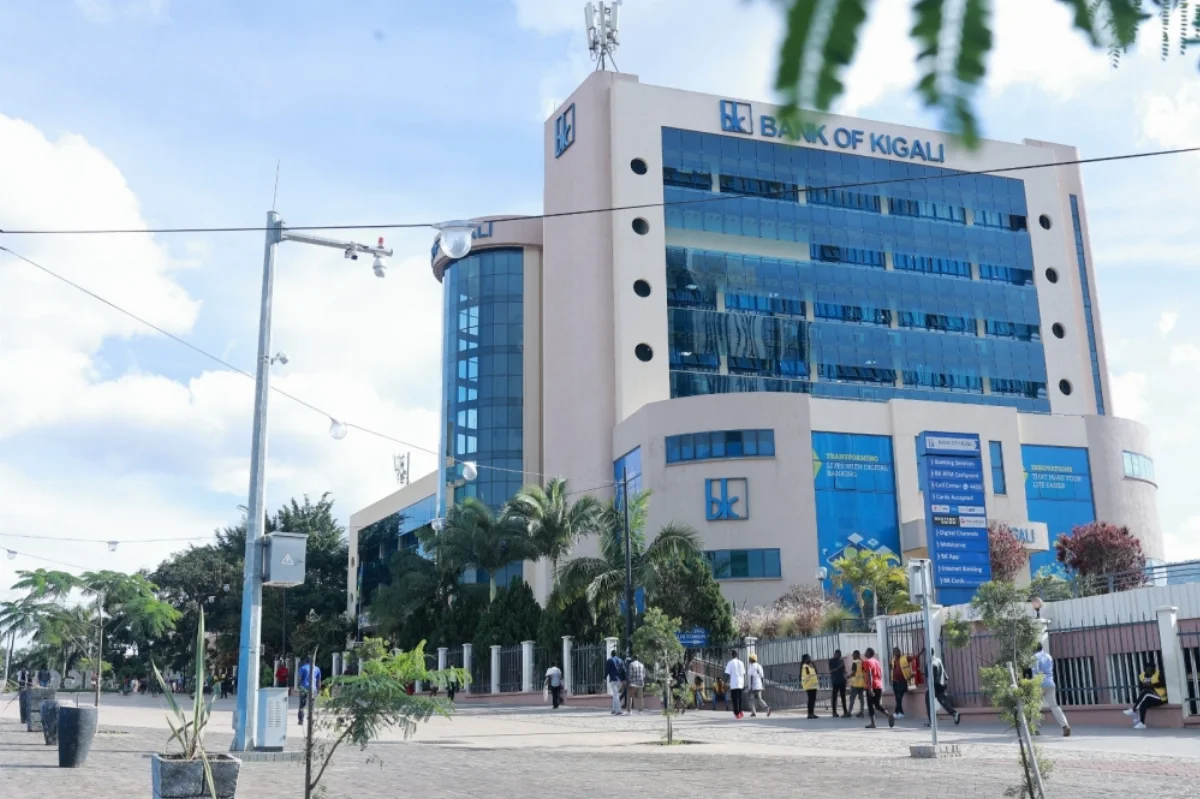
Sixty years ago, Bank of Kigali opened as a single lender in a country still finding its financial footing. Today it isn’t really accurate to call it a bank anymore. It’s a group, and the distinction matters more than it sounds like it should.
BK Group Plc is Rwanda’s largest financial services provider, and it holds that position by a wide margin. It’s built around five subsidiaries, each doing a different job: Bank of Kigali handles retail and corporate banking, BK General Insurance covers motor, transport, engineering, and personal accident insurance, BK Capital runs investment and wealth advisory services, BK TecHouse builds digital products across fintech, edtech, and agritech, and BK Foundation manages the group’s community and impact work. The bank is cross listed on both the Rwanda Stock Exchange and the Nairobi Securities Exchange, which puts it in a small category of Rwandan companies with genuine regional investor reach.
What the Numbers Actually Say
For the financial year ending December 2025, BK Group posted a net profit of Rwf110.1 billion, up 22.9 percent from Rwf91 billion the year before. Group CEO Uzziel Ndagijimana tied the results to Bank of Kigali’s 60th year of operation, and the underlying figures back up the milestone framing. Total assets grew 15.8 percent to Rwf2,919 billion. Customer loans rose 16.1 percent to Rwf1,688 billion, and deposits climbed 14.8 percent.
The composition of that lending is arguably the more interesting story than the headline profit number. Bank of Kigali CEO Dr. Diane Karusisi has been public about wanting to shrink the bank’s reliance on large corporate clients, which still make up 55.5 percent of lending, in favor of SMEs, retail, and agriculture. SME lending alone grew 37.5 percent to Rwf285.1 billion in 2025, and agricultural financing rose to Rwf93.4 billion. “We want to bring corporate banking below 50 percent so that we can increase access to finance for segments that were previously underserved,” Karusisi said, a goal that reads less like a slogan and more like an actual strategic pivot given how fast the SME book is growing.
ALSO READ: How eKash Is Quietly Rewiring Kigali’s Markets
The Subsidiaries Are Not Equal
This is where a BK Group profile gets more honest than most. Not every arm of the ecosystem is performing the same way. BK Insurance had a strong year, with gross written premiums up 22.3 percent to Rwf4.30 billion and net profit up 58 percent to Rwf1.15 billion. BK Capital’s momentum was even sharper, with assets under management jumping 66 percent year on year to Rwf153.1 billion, marking a return to profitability after a rougher stretch. BK TecHouse, on the other hand, posted a loss of Rwf206 million in the first quarter of 2026, with flat revenue and margins squeezed by rising operating costs. It’s a reminder that “ecosystem” doesn’t mean every piece grows at the same pace, and the tech and innovation arm is clearly still finding its footing while the financial subsidiaries carry the group.
The Latest Quarter Tells a Sharper Story
The 2025 annual numbers set the stage, but Q1 2026 results, announced June 5, show where the momentum is actually heading. Bank of Kigali posted a Profit After Tax of Rwf 26.1 billion for the quarter, up 3.5 percent year on year, a more modest pace than the annual figure but consistent with a bank deliberately reshaping its loan book rather than chasing growth for its own sake.
The reshaping shows up clearly in the breakdown. SME financing rose to Rwf 309.2 billion, a 9 percent year to date increase. Retail lending climbed to Rwf 368.9 billion, up 6 percent. Agricultural financing reached Rwf 96.3 billion. Corporate and institutional lending, meanwhile, actually fell 6 percent year to date to Rwf 969 billion, which Karusisi described as planned attrition rather than a downturn, in line with the bank’s stated goal of pulling below 50 percent reliance on large corporate clients.
Two product launches during the quarter are worth naming specifically, since they show where BK is actually placing its bets. BK Open API lets external platforms plug directly into the bank’s infrastructure, so payments, account checks, and bill settlements can happen inside apps people already use, without them ever opening a banking app. BKreative, aimed squarely at Rwanda’s creative industries, offers production financing up to Rwf 1 billion secured, invoice discounting up to 70 percent of a signed contract’s value, and unsecured personal loans up to Rwf 50 million, a notably specific bet on creative businesses as a growth segment most banks overlook.
At the group level, net income rose 6.9 percent year on year to Rwf 26.9 billion, with total operating income up 13.8 percent to Rwf 72.3 billion. Return on average equity reached 20.9 percent, and total assets crossed Rwf 2,947.3 billion. Ndagijimana pointed to “intra-group synergies” as part of the strategy, corporate language for a fairly simple idea: the more the five subsidiaries feed each other customers and data, the harder the whole group is to compete with individually.
ALSO READ: Investment Incentives in Rwanda
Why It Matters Beyond the Balance Sheet
Digital adoption is quietly one of the more telling numbers in the group’s recent results. Karusisi noted that 62.9 percent of Bank of Kigali’s retail clients are now active on digital channels, up from 50.3 percent a year earlier. That shift matters for a country pushing hard toward a cashless economy through systems like eKash, since BK Group’s retail base essentially functions as a live test of how fast that transition is actually happening on the ground, not just in policy documents.
For a business or investment audience, BK Group is close to a proxy for Rwanda’s formal economy itself. When its corporate lending book shrinks in favor of SMEs and agriculture, that’s not just an internal banking strategy. It’s a signal about where the country’s growth is expected to come from next.
Sources: Bank of Kigali press release (June 5, 2026), KT Press, allAfrica, AfricanFinancials, MarketScreener.